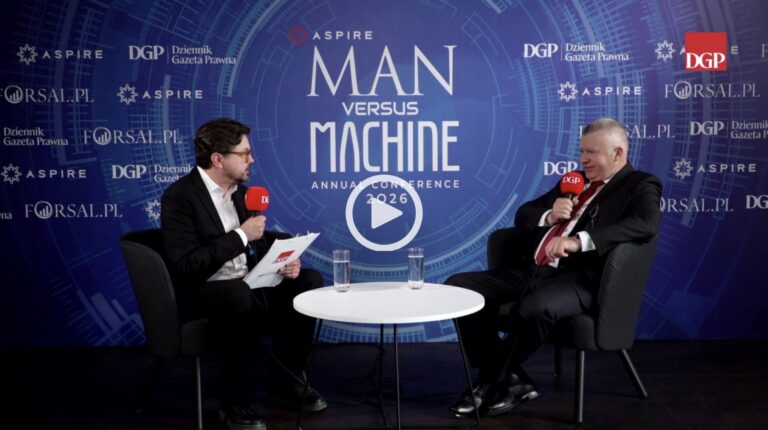
Poland’s business services sector is moving from a cost advantage to a skills advantage. Arkadiusz Wiśniewski, Mayor of Opole, and Marcio Costa of ASPIRE’s Management Board discussed what that means in the DGP studio at ASPIRE 2026: Man vs Machine.
Marcio said investors now look well beyond cost: to talented people, flexibility, economic stability, good universities and how quickly people adapt to new technology, as well as to cooperation with local government and less bureaucracy. He pointed not only to Kraków and Warsaw but to Katowice, Opole and other cities of southern Poland. AI, he said, will support people rather than change the direction of the labour market.
For the Mayor, the sector is above all a chance to keep young people in the city. Mid-sized cities like Opole are fighting to grow quickly and not fall behind the big ones, so they must combine available workers, their universities (the University of Opole and Opole University of Technology), infrastructure, help from the city and quality of life. Opole offers investment land in an economic zone and help from building and environmental permits to public transport planning. He spoke of declarations from a Korean and an American investor for large projects, and of plans for shared service centres working with the universities.
For ASPIRE, this points to ASPIRE 2 Grow: extending our network across southern Poland through the South Poland Business Initiative.
Thank you to Arkadiusz Wiśniewski and the City of Opole, to Marcio, and to Krzysztof Ratnicyn, Dziennik Gazeta Prawna and Forsal.pl.
Source: Forsal.pl, “Inwestycje: Polska przechodzi od przewagi kosztowej do przewagi kompetencji”, 5 October 2026 (video interview in Polish).